Clipless Pedals, Cleats and Pedaling Efficiency: Why Pulling Up Is Not the Whole Answer
Do Clipless Pedals Improve Cycling Efficiency?
Clipless pedals are often explained with a simple promise: they let you pull up as well as push down. In theory, this should make the pedal stroke smoother, reduce peak force and improve cycling efficiency.
But is that really the main reason clipless pedals and stiff cycling shoes are useful?
My current answer is: probably not.
Clipless pedals may reduce peak force and improve control at the foot–pedal interface. But pulling up does not automatically make cycling more efficient. The more interesting benefit may be stability, repeatability and a more predictable connection between rider and bike.
TL;DR
Clipless pedals do not automatically improve cycling efficiency just because they allow the rider to pull up during the pedal stroke.
They can reduce peak force and change the pedal-force curve, but the crank only benefits from the force component that creates torque. In a simplified shoe model, direct mechanical losses at the shoe appear small — only a few watts.
The more important benefit of clipless pedals may be control: a stable, repeatable foot position and a clearer mechanical interface between rider and bike.
Pedal force is not the same as useful crank torque
A large force can act on the pedal without fully contributing to propulsion. For crank torque, the most important part is the tangential force component — the component that acts approximately perpendicular to the crank arm.
This effective component creates torque:
$$ M = F_{\mathrm{tangential}} \cdot r $$
Here, (M) is crank torque, $(F_{\mathrm{tangential}}$) is the tangential force component and (r) is crank length.
A force that acts mostly radially toward the crank axis can be large, but it creates little useful torque. That is why total pedal force alone is not enough to understand pedaling efficiency.
In cycling biomechanics, this relationship is often described as pedal force effectiveness. It refers to the ratio between the effective force that produces crank torque and the resultant total pedal force over a full crank revolution.
In simple terms: not every force that goes into the pedal becomes useful crank work.
What happens if you only push down?
In a simplified model, the difference is easy to see.
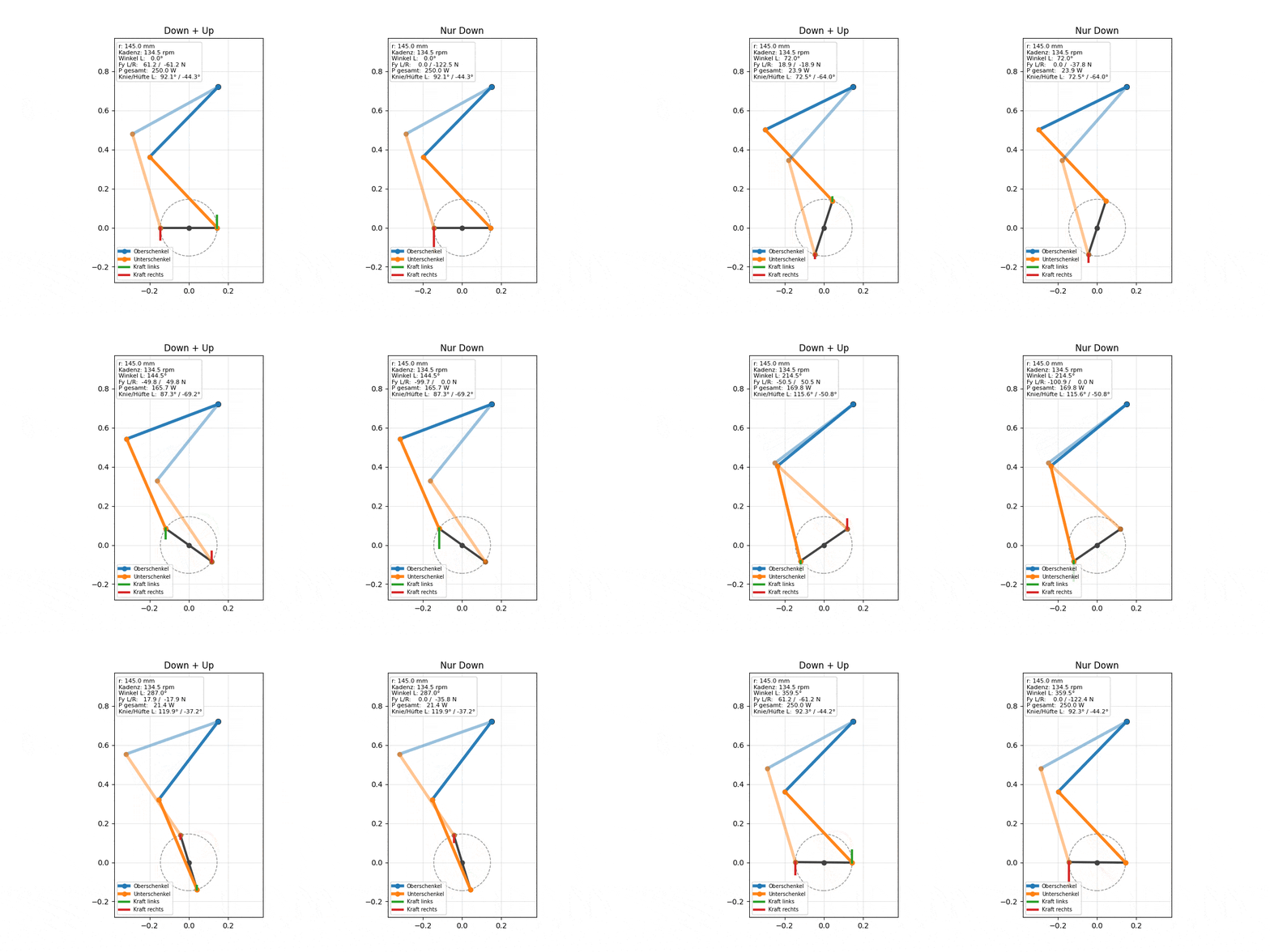
If useful force is generated only during the downstroke, the active phase is short. To produce the same average power over a full crank revolution, the force during that short phase has to be higher.
If useful force is spread over a larger angular range — for example by adding an active pulling phase — peak force can be lower.
But that only means the load is distributed differently.
It does not automatically mean that the rider works more efficiently, or that more power reaches the rear wheel.
Why “round pedaling” is not automatically better
The idea of a round pedal stroke is attractive. If the force curve becomes smoother over the crank cycle, it looks mechanically cleaner: fewer dead spots, fewer negative forces and more continuity.
But a smoother force curve is not automatically better.
The human body is not an ideal electric motor. Muscles work differently depending on joint angle, contraction velocity and activation pattern. A movement that looks mechanically smoother can still cost more energy biologically.
That is why research on active pulling and round pedaling is cautious. Pulling up can improve pedal force effectiveness and reduce negative force during the upstroke. But continuous active pulling is not clearly proven to improve steady-state cycling efficiency.
That was the starting point for my simulation: if active pulling is not clearly the main advantage, what are clipless pedals actually for?
Looking at the foot–pedal interface
The next logical layer is the interface between rider and bike: shoe, cleat and pedal.
In a second simplified model, I looked at what may happen at this interface. The idea was to connect force at the forefoot with a small deformation of the shoe, and then estimate how much mechanical energy could be dissipated during loading and unloading.
The model is intentionally simple:
- it estimates a normal force at the shoe,
- converts that force into deformation using a linear stiffness,
- and treats a fixed fraction of the loading work as hysteresis loss.
This is not a validated model of a cycling shoe. It is a simplified model to build intuition.
As a reference point, I looked at published data on foam mechanics in racing shoes, including the work by McCulloch, Delp and Kuhl on ultra-low density elastomeric foams in elite-level racing shoes.
The important point is not the exact number. The important point is the order of magnitude.
In this simplified model, the direct mechanical losses related to the shoe are only a few watts.
Compared with aerodynamic losses in cycling, that is very small. So I would not choose clipless pedals mainly because of a large direct energy-saving effect at the shoe.
Why stiff cycling shoes still make sense
Even if the direct energy loss in the shoe is small, shoe stiffness is not irrelevant.
A soft shoe can deform under load. This can slightly change foot position, move the pressure point and allow part of the movement to happen inside the interface instead of being transferred clearly to the crank.
A stiff cycling shoe reduces these degrees of freedom.
That does not necessarily mean that every pedal stroke becomes more efficient. But it does mean that the interface becomes more stable and more repeatable.
This is where I see the more important benefit of clipless pedals and cleats:
They make the connection between rider and bike more defined.
The foot is positioned more repeatably on the pedal. The forefoot is more stable under load. Pedal position becomes less random. Force application becomes more predictable.
This is less about “more watts from pulling up” and more about control.
Clipless pedals as a control system
Clipless pedals reduce degrees of freedom at the foot–pedal interface. The foot cannot freely slide, rotate or reposition itself on the pedal.
This can have several effects:
- a more stable foot position,
- more repeatable force application,
- better control at high loads,
- less uncertainty at the contact point,
- a clearer connection between leg movement and crank motion.
Especially during hard accelerations, high cadence, out-of-saddle efforts or technical riding situations, this connection may matter.
The benefit is not necessarily that both legs constantly pull on the pedals. The benefit may be that the rider gets a more reliable mechanical interface with the bike.
This also connects to a broader question in cycling data analysis: how do we separate the mechanical behavior of the bike from the human control strategy? That question appears in many areas of cycling dynamics, from pedal force to cornering and bike handling.
For more on the measurement side of cycling dynamics, see the RaceYourTrack article on measuring road-bike cornering dynamics.
Mechanical efficiency or human efficiency?
A key distinction is the difference between mechanical efficiency and metabolic efficiency.
Mechanically, we would ask how much of the work introduced at the foot arrives as crank work. To answer that properly, we would need the complete force vector at the shoe–pedal interface — not only the tangential component, but also the magnitude and direction of the total force over the full crank cycle.
Metabolically, we would ask how much crank work the body can produce per unit of energy consumed. That depends not only on mechanics, but also on muscle coordination, joint moments, activation patterns and training status.
That is why this topic is more difficult than it first appears.
A pedal can be mechanically ideal. The human rider is not.
What the simulation can show — and what it cannot
The simulation can help visualize orders of magnitude and mechanical relationships. It can show how an assumed force pattern affects crank torque, peak force or shoe deformation.
But it cannot automatically predict which force strategy a real rider will choose.
The torque-vs-crank-angle curve in the model is an assumption. The direction of pedal force is also modeled, not measured. A real rider can produce different force vectors with the same leg kinematics.
This is especially important when discussing forward pedaling, backward pedaling, active pulling or round pedaling. The crank mechanics alone do not tell us how the human body will actually coordinate the movement.
What would need to be measured?
To answer the efficiency question more clearly, we would need more than a crank-based power measurement.
A crank power meter measures net rotational power at the crank. That is very useful for training, but it does not directly show what happens upstream at the foot–pedal interface.
Useful additional measurements would include:
- the complete pedal force vector,
- the center of pressure under the foot,
- shoe deformation under load,
- joint angles and joint moments,
- muscle activation,
- comparisons between flat pedals, clipless pedals and different shoe stiffnesses.
Only then could we better separate direct mechanical energy savings from improved force direction or changes in human coordination.
What does this mean in practice?
From my perspective, clipless pedals are not a magic efficiency device.
They allow force to be applied in more directions and over a larger part of the crank cycle. But active pulling alone is probably not the main reason they are used in cycling.
A more plausible explanation is a combination of control, stability and repeatability.
Clipless pedals make the connection between rider and bike more clearly defined. That can make force application easier under real riding conditions, even if the direct energy saving at the shoe is small.
So the better question may not be:
“How many watts do clipless pedals save?”
But rather:
“How do clipless pedals change the interface through which the rider transfers force, control and coordination to the bike?”
FAQ
Do clipless pedals make cycling more efficient?
Not automatically. Clipless pedals can change force application and improve control at the foot–pedal interface, but pulling up during the pedal stroke is not clearly proven to improve steady-state cycling efficiency.
Are clipless pedals more efficient than flat pedals?
They can be more stable and repeatable, especially under high load or high cadence. But the efficiency difference depends on the rider, the task and how efficiency is measured. The main benefit may be control rather than a large direct energy saving.
What is pedal force effectiveness?
Pedal force effectiveness describes how much of the total pedal force actually contributes to crank torque. A high total force is not necessarily useful if much of it acts in a direction that does not turn the crank.
Why are cycling shoes stiff?
Stiff cycling shoes reduce deformation at the foot–pedal interface. This can make the foot position more stable and force application more repeatable, even if the direct energy saving in the shoe is small.
Do you need to pull up with clipless pedals?
Not necessarily. Clipless pedals allow pulling, but their practical value may be more about stabilizing the foot, reducing unwanted movement and making the rider-bike connection more predictable.
Conclusion
Clipless pedals and stiff cycling shoes should not be explained only through the classic argument of pulling up.
Yes, an active pulling phase can reduce peak force and change the shape of the pedal-force curve. But that does not automatically mean higher overall efficiency.
The direct mechanical energy loss in the shoe appears small in a simplified estimate. The bigger benefit is probably somewhere else: in a more stable, more controllable and more repeatable connection between rider and bike.
For RaceYourTrack, this is exactly the interesting part. Cycling is not only about power, speed and distance. It is a coupled system of human movement, mechanics and data. The foot–pedal interface may be small, but it is central: this is where muscle work becomes crank torque.
And that is why it is worth looking not only at the power measured at the crank, but also at how that power is created in the first place.
References and starting points
Bini, R. R., Hume, P. A., Croft, J., & Kilding, A. E. (2013). Pedal force effectiveness in Cycling: a review of constraints and training effects. Journal of Science and Cycling, 2(1), 11–24.
McCulloch, Delp & Kuhl. Discovering the mechanics of ultra-low density elastomeric foams in elite-level racing shoes. DOI: 10.48550/arXiv.2602.12694
Note
This article describes a simplified mechanical model and a physical interpretation. It is not a validated measurement of a specific shoe, pedal or rider, and it does not replace a biomechanical laboratory analysis.