Oval Chainrings, Pedal Force Effectiveness and Power Meters: What Really Happens When You Pedal
Oval Chainrings, Pedal Force Effectiveness and Power Meters: What Really Happens When You Pedal
Oval chainrings are a good example of why cycling performance is not only about power, but also about the timing of force.
At first glance, an oval chainring is just a chainring that is not perfectly round. In practice, however, there is an interesting mechanical idea behind it: the resistance should feel slightly different across the crank revolution than it does with a round chainring. In the parts of the pedal stroke where the rider can apply force more effectively, the effective gearing changes differently than in the parts where the crank mechanics are less favourable.
This makes an important point visible: crank angle matters. A force on the pedal is not equally useful in every crank position. Depending on where the crank is, the same pedal force can create a lot of useful torque, only a little torque, or almost none at all.
That is where the discussion becomes interesting. A power meter shows watts. This number is extremely useful for training, pacing and analysis. But it does not automatically show how the force at the pedal was created or how well it was aligned with the crank motion.
Two riders can produce the same power and still pedal very differently from a mechanical point of view. The display may show 250 watts in both cases, but the pedal forces behind that number can be quite different.
Summary
Oval chainrings, Pedal Force Effectiveness and power meters belong to the same mechanical discussion because all three are connected to crank angle, torque and force distribution.
Oval chainrings change the effective gearing across the crank revolution. They are based on the idea that the human body cannot produce force equally well in every crank position.
Pedal Force Effectiveness, often simply called Force Effectiveness or FE, describes how much of the total pedal force actually contributes to crank torque. For propulsion, the most important part is the force component that acts tangentially to the crank path.
A power meter measures power or torque at a specific point in the drivetrain. It usually does not measure the complete force vector at the pedal. This means watts show what arrives mechanically at the measurement point, but not the full story of how that power was produced.
Oval chainrings as a useful starting point
The idea behind oval chainrings is quite intuitive. The human body does not pedal like a perfect motor. In some parts of the crank revolution, the hip, knee and ankle can apply force more effectively. In other parts, especially near the dead spots, the mechanics are less favourable.
An oval chainring tries to respond to this uneven human force production by changing the effective gearing across the pedal stroke. Whether this gives a clear benefit for every rider depends on many factors: position, cadence, riding style, chainring shape, adaptation and the rider’s individual force pattern.
For a biomechanical discussion, however, the basic idea is already useful. Oval chainrings remind us that a crank revolution is not mechanically the same everywhere. A force that is very effective in one part of the stroke can contribute much less to forward motion in another part.
This leads naturally to Pedal Force Effectiveness.
Watts are an output value
Watts are important in cycling for good reason. They are useful for pacing, intervals, long climbs, testing and objective analysis of load. For RaceYourTrack, power data are also central because they make riding situations more measurable and comparable.
Still, watts are first of all an output value. They tell us how much mechanical power arrived at a certain measurement point in the drivetrain. They do not automatically tell us how much total force was required at the pedal, or in which direction that force acted.
That is the interesting gap. Between the foot and the power meter, force is transmitted. Part of this force creates crank torque. Another part may load the system without turning the crank very effectively.
A power meter therefore provides a very important number, but it does not always tell the full mechanical story.
The crank responds to torque
For the crank, the decisive factor is not the total pedal force, but the part of the force that creates torque. This useful component acts perpendicular to the crank arm and tangentially to the circular path of the crank.
In simplified form:
$$ M = F_{\mathrm{tangential}} \cdot r $$
Here, $M$ is crank torque, $F_{\mathrm{tangential}}$ is the tangentially effective pedal force and $r$ is crank length.
A radial force, on the other hand, acts towards or away from the crank axle. It can be large, but it does not turn the crank. It loads the foot, shoe, cleat, pedal and body, but does not contribute directly to crank torque.
This is why pedal force is not automatically propulsion. What matters is not only how much force is applied, but also how that force is aligned with the crank.
Pedal Force Effectiveness explained
Pedal Force Effectiveness, or Force Effectiveness, describes the relationship between useful pedal force and total pedal force.
A simple mechanical expression is:
$$ FE = \frac{F_{\mathrm{tangential}}}{F_{\mathrm{total}}} $$
In words, Pedal Force Effectiveness describes what fraction of the total pedal force acts in a direction that creates crank torque.
If a large part of the pedal force acts tangentially, FE is high. If a lot of the force acts radially or in a less useful direction, FE is lower.
This makes FE an interesting value, but also one that must be interpreted carefully. Mechanically, high FE is attractive because more of the applied pedal force is directly useful for turning the crank. For the human body, however, this force strategy is not automatically more efficient. Muscle function, joint angles, stabilization, fatigue and coordination all play a role.
The rider is not an electric motor. A mechanically clean force vector is not automatically the most energy-efficient solution for the body.
What a power meter actually measures
A power meter does not simply measure how hard someone presses on the pedal. Depending on the design, it measures torque and angular velocity, or signals from which power can be calculated.
The basic relationship is:
$$ P = M \cdot \omega $$
Here, $P$ is power, $M$ is torque and $\omega$ is angular velocity.
Torque comes from the tangentially effective force. Angular velocity is connected to cadence.
A power meter can be located in different places: e.g. in the pedal or crank arm. Depending on the system, it does not measure exactly the same point in the drivetrain. But the basic idea is the same: it measures mechanical power in the drivetrain.
What it usually does not show completely is the full force vector at the pedal. It does not automatically show the direction of pedal force, the radial force component, the point of force application under the foot, or possible deformation in the shoe and pedal interface.
That is why watts can be very precise and still leave open how effectively the pedal force was aligned.
Same watts, different mechanics
A simple comparison makes this clear. Two riders both produce 250 watts. On the power meter, this looks the same.
Mechanically, however, the path to those watts can be different. One rider may apply a large part of the pedal force tangentially into the crank. Pedal Force Effectiveness is high, and less total pedal force is needed to create the required torque.
Another rider may produce the same power with more radial or less effectively directed force. FE is lower. For the same watts, more total pedal force may be required.
This does not automatically mean that the second rider is riding badly. That force strategy might make sense for their joints, stability or coordination in that moment. But mechanically, the difference is real.
Equal watts do not automatically mean equal pedalling mechanics.
What the animation shows

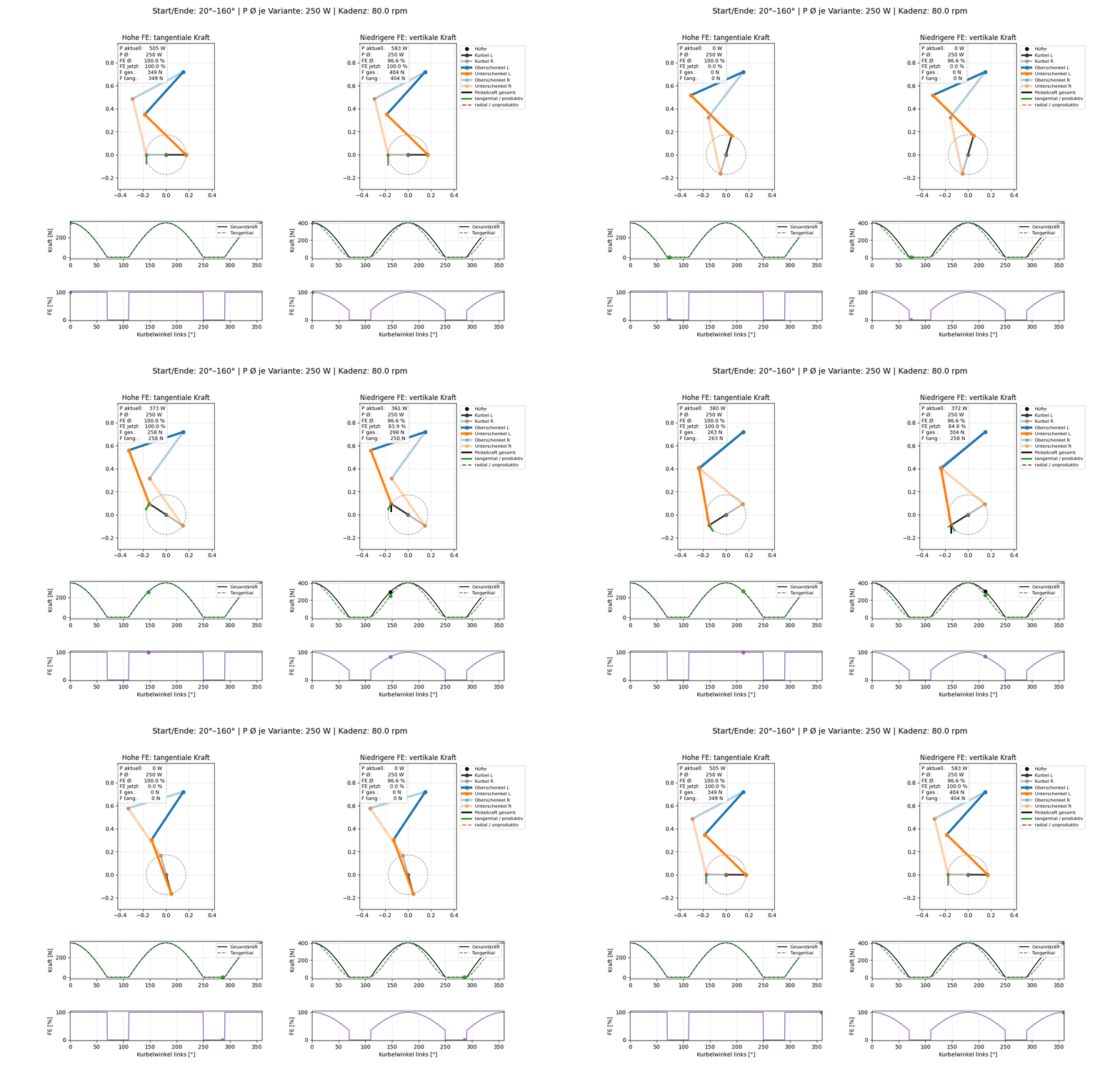
Simplified comparison of two force models with the same average power. On the left, force acts tangentially to the crank path. On the right, force acts vertically. The vertical-force version reaches the same average power but needs more total pedal force and shows lower Pedal Force Effectiveness.
The animation shows two simplified variants with the same average power: 250 watts at 80 rpm. In this example, the active force window is between 20° and 160° crank angle.
On the left, the force is aligned tangentially to the crank path. Almost all of the pedal force acts in the direction that creates crank torque. This is why Pedal Force Effectiveness is close to 100 percent in the active part of the stroke.
On the right, the force is vertical. This version also produces the same average power, but the force is not equally well aligned with the crank across the whole crank angle range. Part of the force acts radially and contributes less to torque. FE therefore drops, even though average power stays the same.
This is the central point: equal watts can be created by different mechanics. A power meter shows the resulting power, but not automatically how much additional or poorly directed force was needed at the pedal.
Why vertical force is only part of the story
Many simple models first imagine pedal force as vertical: the foot presses down, the pedal moves and the bike goes forward.
In certain crank positions, this is a useful approximation. When the crank is roughly horizontal, a vertical force can create torque very effectively. Near the top and bottom dead spots, the situation is different. A larger part of the same vertical force acts more radially and creates less useful crank torque.
This is why crank angle matters. It is also why oval chainrings are such a useful starting point for this discussion. They make it visible that the crank revolution is not mechanically identical everywhere, and that force, angle and timing belong together.
Oval chainrings do not change the formula for Pedal Force Effectiveness. But they do change effective gearing across the crank angle, and therefore the feeling and distribution of load during the pedal stroke.
Pedal Force Effectiveness asks how well the force at the pedal is aligned. Oval chainrings are more about when a certain effective gearing occurs during the crank cycle. Both topics point to the same mechanical foundation: within one crank revolution, more happens than a single watt value can show.
What data would be needed for Pedal Force Effectiveness
To calculate Pedal Force Effectiveness properly, a normal power value is not enough. At minimum, the pedal force vector and crank angle are needed.
In practice, pedal forces in two directions would be useful, for example $F_x$ and $F_y$. From these components, the resulting total force can be calculated:
$$ F_{\mathrm{total}} = \sqrt{F_x^2 + F_y^2} $$
Crank angle is also needed because the tangential direction changes continuously during the crank revolution. Crank length is required if torque should be calculated from tangential force. Cadence, or angular velocity, becomes important as soon as torque is converted into power.
For instantaneous Pedal Force Effectiveness, the force vector and crank angle are the key pieces. To connect this to power, crank length and cadence are added.
Ideally, the left and right pedals would also be measured separately because many riders do not pedal perfectly symmetrically. A single total power value can easily hide these differences.
Pedal Force Effectiveness is not Pedal Smoothness
Pedal Force Effectiveness is sometimes mixed up with a round pedal stroke or Pedal Smoothness. These concepts should be kept separate.
Pedal Smoothness describes how evenly torque or power is distributed across the crank revolution. Pedal Force Effectiveness describes how well the force at the pedal is aligned.
A pedal stroke can look smooth and still contain a lot of poorly directed force. On the other hand, a less smooth stroke can contain very effective force peaks.
A round pedal stroke is therefore not automatically an efficient pedal stroke. And high FE does not automatically mean that the body uses less energy.
Conclusion
Oval chainrings are a useful entry point into this topic because they show that crank angle is mechanically important. They lead directly to the larger question of how force acts across the crank revolution and what a power meter actually makes visible.
Pedal Force Effectiveness goes one step deeper. It describes what fraction of total pedal force actually creates crank torque. For crank torque, the tangential force component is what matters most. Radial force components can be large, but they contribute little to direct crank work.
A power meter measures the power that arrives at a specific point in the drivetrain. This is extremely valuable, but it does not automatically show how much total pedal force was required or how that force was directed.
Watts show what comes out. Pedal Force Effectiveness helps explain how it was produced mechanically.
Note
This article is a simplified mechanical explanation. It does not replace a biomechanical laboratory analysis and is not a validated measurement of a specific rider, pedal, shoe or chainring. The goal is to make the basics of pedal force, crank torque, power-meter measurement, oval chainrings and Pedal Force Effectiveness easier to understand.