Cycling Physics: Gravity, Rolling Resistance, and Aerodynamics—Explained with Formulas
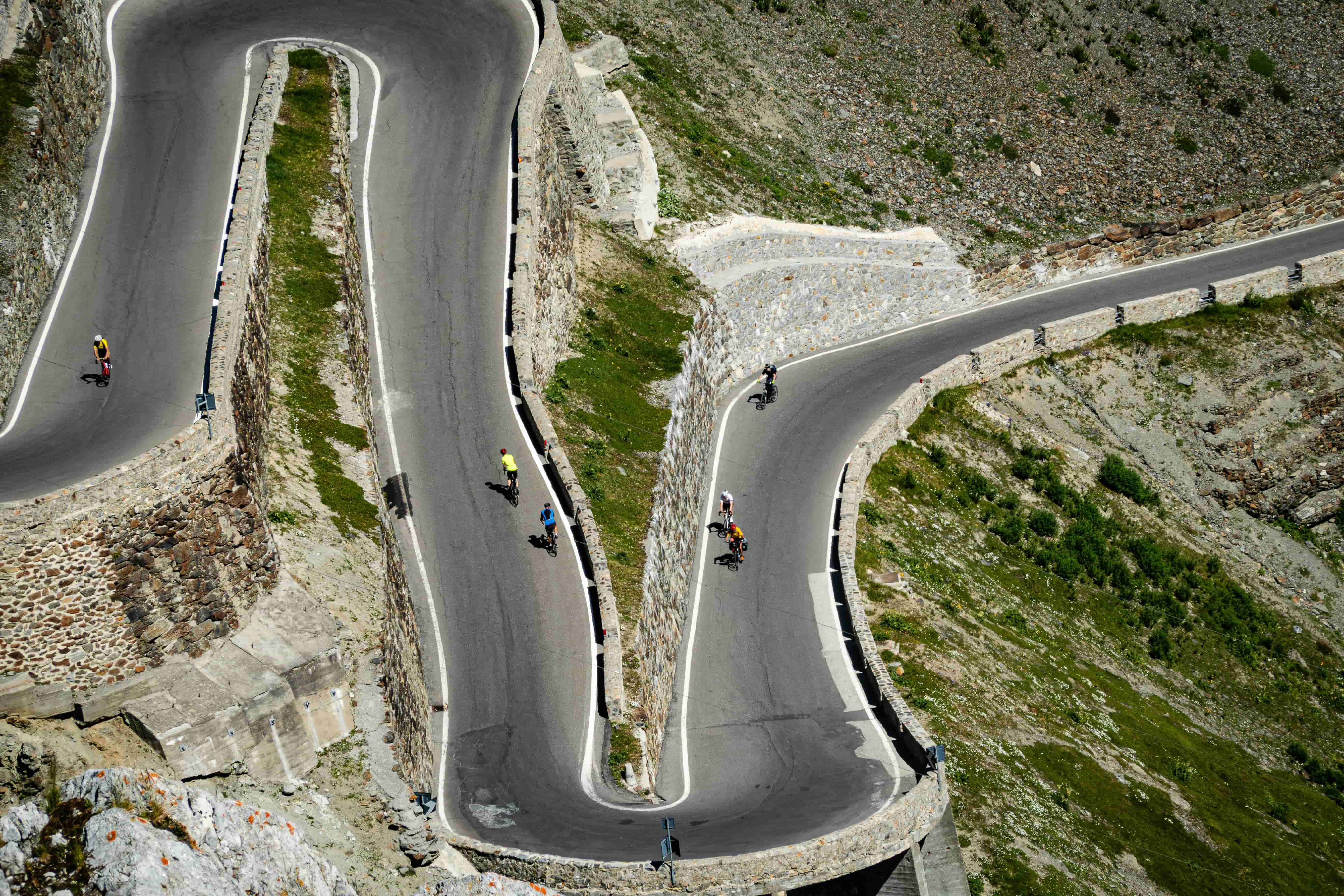
Cycling Physics: Why some watts buy more speed than others
Whether you ride road, gravel, triathlon, time trial, or commute by bike, three forces determine how much power you need to hold a given speed. If you understand when aerodynamic drag dominates, when tires matter most, and why climbing gets expensive so quickly, you can make much smarter choices about equipment and pacing.
The total resistive force is the sum of:
$$ F_{\text{total}} = F_{\text{aero}} + F_{\text{roll}} + F_{\text{grav}} $$
The required power is then force times speed:
$$ P = F_{\text{total}} \cdot v $$
In the real world, a small part is lost through the drivetrain and mechanical friction. That can be expressed using an efficiency factor $\eta$ (typically around $0{,}96$ to $0{,}99$):
$$ P_{\text{rider}} \approx \frac{P}{\eta} $$
Aerodynamic drag
Aerodynamic drag dominates at higher speeds. The force increases with the square of your speed relative to the air. In calm conditions, you can approximately use $v$; with wind, you need to use the relative airspeed $v_{\text{rel}}$ instead.
$$ F_{\text{aero}} = \frac{1}{2} \, \rho \, C_dA \, v^2 $$
Here, $\rho$ is air density and $C_dA$ is the key aerodynamic metric that reflects body position, clothing, helmet, cockpit setup, and everything else exposed to the wind. From force, power follows as:
$$ P_{\text{aero}} = F_{\text{aero}} \cdot v = \frac{1}{2} \, \rho \, C_dA \, v^3 $$
That $v^3$ relationship explains why aero improvements are especially valuable at high speed on flat terrain or into a headwind.
Gravity (climbing)
On a climb, you have to work against gravity. For a road with slope angle $\theta$, the exact gravitational component is:
$$ F_{\text{grav}} = m \cdot g_0 \cdot \sin(\theta) $$
In practice, riders often work with road grade $s$ instead (for example, $5\% \Rightarrow s=0{,}05$). For typical cycling gradients, $\sin(\theta) \approx s$ is a very good approximation (and $\tan(\theta) \approx s$ as well), so:
$$ F_{\text{grav}} \approx m \cdot g_0 \cdot s $$
Here, $m$ is the total mass of rider, bike, and gear, and $g_0 \approx 9{,}81\,\text{m/s}^2$ is gravitational acceleration. The corresponding power is:
$$ P_{\text{grav}} = F_{\text{grav}} \cdot v \approx m \cdot g_0 \cdot s \cdot v $$
This term scales linearly with $v$. That is why weight, gradient, and pacing are so tightly linked on climbs.
Rolling resistance
Rolling resistance comes from tire deformation and surface losses. The force is typically modeled as:
$$ F_{\text{roll}} = C_{rr} \cdot m \cdot g_0 $$
Strictly speaking, rolling resistance acts on the normal force, so:
$$ F_{\text{roll}} = C_{rr} \cdot m \cdot g_0 \cdot \cos(\theta) $$
For normal road gradients, $\cos(\theta) \approx 1$, so the simplified expression above is usually more than accurate enough.
$C_{rr}$ is the rolling resistance coefficient and depends on factors such as tire model, width, pressure, casing, and road surface. The corresponding power is:
$$ P_{\text{roll}} = F_{\text{roll}} \cdot v \approx C_{rr} \cdot m \cdot g_0 \cdot v $$
This term is also linear in $v$. That is why good tires and well-chosen tire pressure can “buy” speed very efficiently.
The compact equation: where your watts really go
Putting all three contributions together gives a very useful approximation for the power required at a given speed:
$$ P \approx \frac{1}{2} \, \rho \, C_dA \, v^3 + C_{rr} \cdot m \cdot g_0 \cdot v + m \cdot g_0 \cdot s \cdot v $$
This lets you frame almost any real-world question: aerodynamics reduces the $v^3$ term and therefore matters most at high speed, tires reduce a linear term and therefore always matter, and weight or gradient mainly act through the climbing term and dominate uphill.
👉 With the Bike Calculator, you can run the numbers directly for your own setup: speed from watts or required watts from speed—including inputs for weight, gradient, $C_dA$ (CdA), $C_{rr}$ (Crr), drivetrain efficiency, and air density based on temperature, elevation, and sea-level pressure (without wind), plus a breakdown of forces and power contributions.
Go to the calculator
Photo credit: Photo by Jose Rodriguez Ortega