TrackIQ Power Strategy: How Simulation Reveals Where Your Watts Really Make You Faster
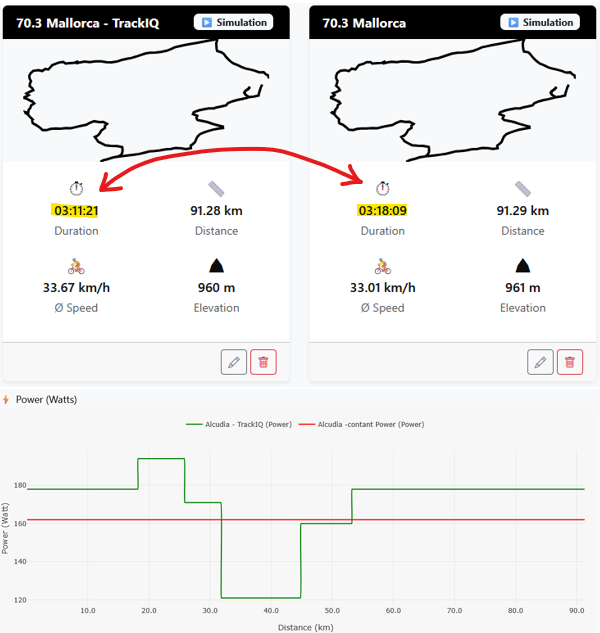
Many triathletes face a deceptively simple but crucial question: Should you hold your target watts steady on the bike leg—or vary your effort based on gradient and course section? Especially on rolling or hilly courses, the answer can mean real minutes gained or lost. Generic pacing advice rarely helps when it comes to your specific course and setup. This is where TrackIQ comes in: With physics-based simulation, RaceYourTrack makes it visible how to distribute your watts so they have the greatest effect on every segment—minimizing your bike split without increasing your overall effort.
The Dilemma: Hold Steady Watts or Vary by Segment?
You’ve built your season around a key race, you know the course—maybe you’ve even imported it via GPX— and now you’re asking: Should I just ride my target watts evenly, or is it worth pushing harder on climbs and backing off on fast sections? The fear of losing time through poor pacing or burning too many matches too early is real. On courses with varied profiles, gut feeling alone often isn’t enough.
Many age-group athletes invest countless hours in training, optimize their gear, and fine-tune nutrition—but the actual power strategy often remains a guessing game. Yet how you distribute your watts determines whether you truly reach your potential or leave valuable minutes on the table.
The key decision isn’t just how many watts you can hold, but where those watts will save you the most time. On a course that’s 80% flat, the difference between steady and segment-based pacing is often small. But on a course with 20% steep climbs, targeted power distribution can make a noticeable difference—without riding any harder overall. Simulation makes these differences visible and provides a solid decision basis.
The Common Mistake: Why Generic Power Targets Waste Time
Standard advice like “ride as steady as possible” or “push a bit more on the climbs” often falls short on real-world courses. The reason: The effectiveness of an extra watt depends heavily on which resistance dominates each section.
- On flat, fast sections, aerodynamic drag is your main opponent. The power required rises roughly with the cube of your speed. An extra watt here yields only a small time gain.
- On climbs, gravity takes over. At lower speeds, an extra watt leads to a much bigger speed increase—and saves more time per unit of energy.
- Rolling resistance matters most on rough surfaces or at lower speeds. Here too, targeted power adjustments can make sense.
Generic power targets ignore these differences. Simulation makes it visible how the interplay of gradient, drag, and rolling resistance affects your time savings per watt—and where targeted effort really pays off. On rolling or hilly courses, ignoring this often means giving away time without realizing it.
For more on how each resistance works, see Cycling Physics: Gravity, Rolling Resistance, and Aerodynamics—Explained with Formulas.
Simulation reveals that an extra watt on a climb often saves several times as much time as the same watt on the flats. Understanding this lets you invest where it counts—and ride more economically on fast sections.
How TrackIQ Segments Your Course by Physics
TrackIQ works like your personal race engineer: It breaks your course into segments where the resistance mix is similar. For each segment, the simulation estimates how much time an extra watt will save—depending on gradient, speed, surface, and aerodynamics.
You control the plan with two parameters:
- Intensity ratio (%): Sets the average effort relative to your threshold (e.g., FTP).
- Max threshold (%): Caps how high individual power spikes can go, keeping the plan realistic and avoiding unsustainable surges.
The result is a segment-based power plan: more watts where they save the most time (like on climbs), consciously backing off on fast flats or descents. Your overall effort stays controlled—you’re not riding harder, just smarter.
If you want to understand the physics behind these effects, the Watt ↔ Speed Calculator: How to Identify the Real Levers on Your Course is a great way to see how watts, weight, and aerodynamics affect your speed.
TrackIQ’s segmentation isn’t arbitrary—it’s based on which resistance dominates. On flat, fast sections, drag is king; on climbs, gravity; on rough surfaces, rolling resistance. The simulation calculates for each segment how much time an extra watt will save, making it visible where varying your power is actually worthwhile.
Scenario Comparison: What Does Targeted Power Distribution Deliver on Your Course?
Simulations with TrackIQ show: On rolling or hilly courses—with longer climbs, changing wind, or rough pavement—targeted power distribution can noticeably reduce your bike split, without increasing your total effort. The time savings come not from working harder, but from using your available energy more effectively.
For example: - On a flat course like Hamburg, drag dominates almost everywhere. Steady pacing is close to optimal, since an extra watt on the flats brings little time gain. - On a course with multiple climbs and descents—like Nice or a typical rolling Ironman—TrackIQ makes it visible that an extra watt on a climb is much more valuable than on the flats, and that segment-based pacing is worth considering.
The simulation factors in your setup (including CdA from real ride data if available), the course profile, and current conditions. This lets you compare different strategies directly and see how changing your power distribution affects your projected bike split.
When you simulate your own course with RaceYourTrack, you can compare steady pacing, segment-based pacing, different intensity ratios, or setup changes. This makes it visible where the biggest lever for your bike split lies—and where extra effort is actually worthwhile.
For a deeper look at how course analysis and simulation work together, see Master Your Race Day with RaceYourTrack.
From Simulation to a Rideable Plan
A segment-based power plan only matters if you can actually execute it in training or on race day. TrackIQ lets you export your plan as a FIT file for Garmin® Edge or as a ZWO workout for Zwift® and MyWhoosh®. This way, your segment-based power targets are right on your bike computer or indoor trainer.
Limiting the max threshold ensures the strategy is rideable in the real world, not just on paper. Simulation helps you compare scenarios: How does your projected time change if you adjust intensity, tweak your setup, or refine the segmentation? The assumptions remain transparent—you see how every change affects both your total effort and your bike split.
For more on practical implementation, see From TrackIQ pacing to your device: FIT export for Garmin® Edge & ZWO workouts for Zwift®/MyWhoosh® etc..
A common challenge: In real races, power targets shouldn’t jump around or become unrealistic. TrackIQ smooths transitions and delivers a plan you can actually follow on race day—not just in the lab.
Conclusion: Simulation Makes It Visible Where Your Watts Matter Most—and How to Optimize Your Strategy
TrackIQ’s core strength is that you no longer have to guess where an extra watt really pays off. The simulation shows you, segment by segment, how your power affects your bike split—and provides a solid basis for your pacing strategy. Especially on rolling or variable courses, this is the difference between “rode solidly” and “left nothing on the table.”
Decision workflow: 1. Import your course (GPX, TCX). 2. Enter your setup and power data (including real CdA if available). 3. Run a TrackIQ simulation and compare scenarios (steady vs. segment-based pacing, etc.). 4. Export your segment-based plan and test it in training. 5. On race day, ride to plan—knowing your watts are working where they matter most.
Simulating your course with TrackIQ reveals which lever has the biggest impact on your bike split—so you can focus your strategy where it counts. That’s high-end engineering for your race day, without a pro team, wind tunnel, or coach’s budget.
These articles might also interest you:
- 10 Watts More or 10 lb Less: What Actually Makes You Faster on the Ironman Bike Course? — 03.06.2026
- Why am I not getting faster on the bike? Weight, watts, tires and aerodynamics explained simply — 09.05.2026
- From TrackIQ pacing to your device: FIT export for Garmin® Edge & ZWO workouts for Zwift®/MyWhoosh® etc. — 14.02.2026
- Master Your Race Day with RaceYourTrack — 24.10.2025