Pacing Optimization on IRONMAN Courses: How TrackIQ Saves Real Minutes at the Same Effort
Many triathletes face the same race-day question: you know your target watts, your equipment is dialed in, and you know the course — but how should you actually distribute your power?
Especially on rolling or hilly IRONMAN courses such as Frankfurt or Klagenfurt, the big question is this: Is steady pacing really optimal, or can targeted power distribution save measurable time without increasing overall effort?
Many age-group triathletes choose constant watts because it feels controlled and safe. The fear is understandable: push too hard in the wrong places, and the run can fall apart. But this is exactly where physics matters.
On climbs, gravity dominates. On fast flat sections, aerodynamic drag dominates. That means one extra watt does not have the same value everywhere on the course.
The key idea is simple: watts are not equally valuable on every segment. By applying power where it creates the greatest speed benefit, athletes can turn the same physiological effort into a faster bike split.
Why Generic Watt Targets Leave Time on the Course
Cycling physics is highly segment-dependent. On fast, flat sections above roughly 19 mph, aerodynamic drag becomes the main resistance. On climbs above about 3%, gravity becomes the dominant force. Rolling resistance also matters, especially on rough pavement or at lower speeds.
That means the time saved per additional watt depends on the segment.
A constant-power strategy may create a steady physiological load, but it does not fully take advantage of the course profile. Two athletes with the same normalized or weighted power can ride the same course in noticeably different times depending on how they distribute that power.
This is where simulation becomes valuable. TrackIQ analyzes each course segment and shows where power is most effective — replacing guesswork with a data-driven pacing strategy. For more background on cycling resistance and the physics behind pacing, see Cycling Physics: Gravity, Rolling Resistance & Aerodynamics Explained with Formulas.
Simulation Example: Two IRONMAN Courses Compared
TrackIQ uses segment-based simulation to calculate which resistance dominates on each part of the course and how power can be distributed most efficiently.
The examples below compare constant pacing with optimized power distribution on real IRONMAN courses.
Setup for both simulations: - Total system weight: 176 lb / 80 kg - Rolling resistance: c_r = 0.003 - Aerodynamics: CdA = 0.30 - FTP: 250 W - Target intensity: 80% / 200 W
Two strategies were compared: - Baseline: constant 200 W across the full course - TrackIQ: same target effort, but segment-optimized power distribution
Important: the weighted power is the same in both strategies. The time gain comes from smarter power distribution — not from riding harder overall.
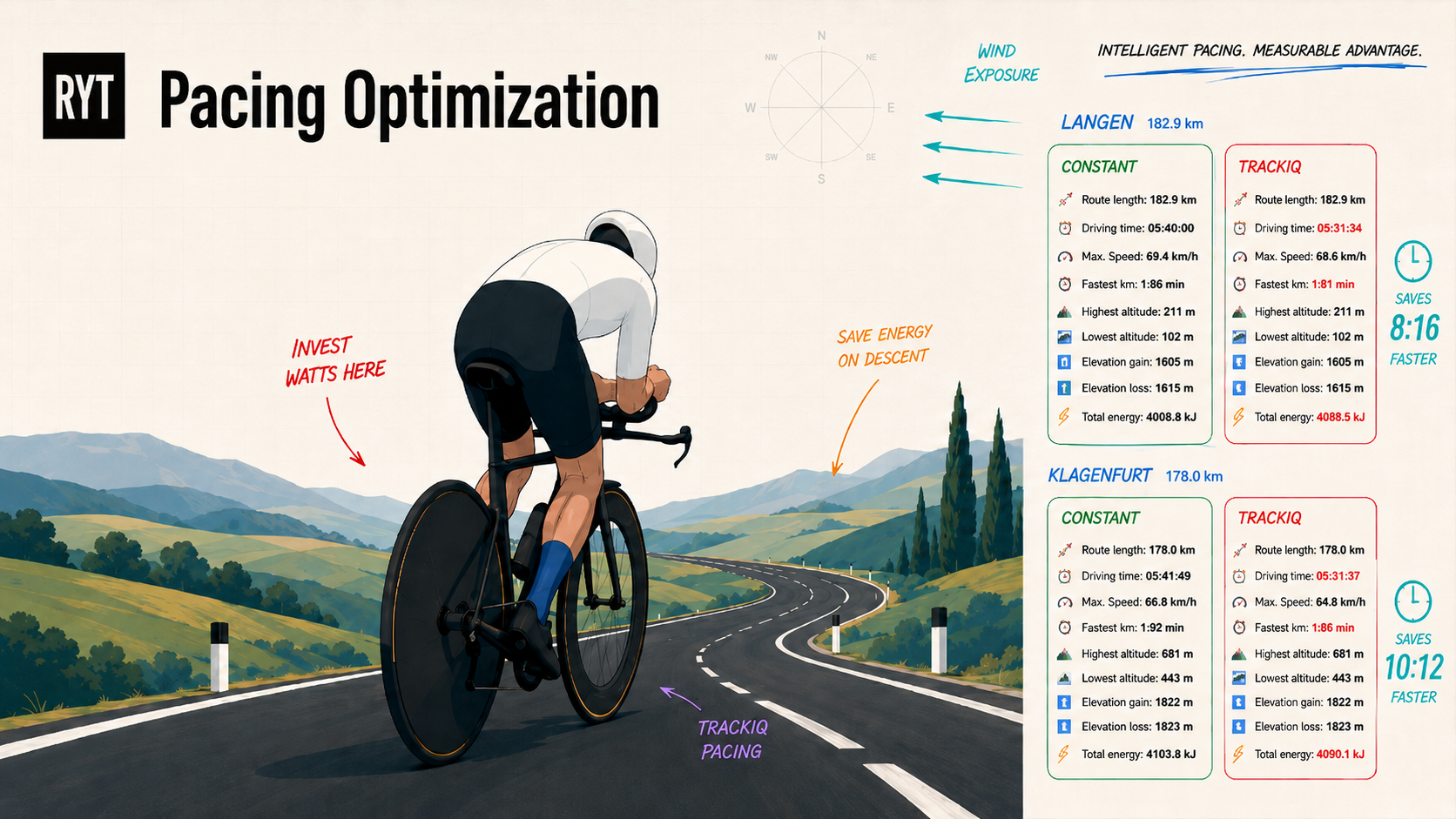
IRONMAN Frankfurt
Course distance: 113.6 miles / 182.9 km
- Baseline: 5:40:00
- TrackIQ: 5:31:44
- Time saved: 8 minutes 16 seconds
- Energy difference: +6.7 kJ, practically identical
IRONMAN Klagenfurt
Course distance: 110.6 miles / 178.0 km
- Baseline: 5:41:49
- TrackIQ: 5:31:37
- Time saved: 10 minutes 12 seconds
- Energy difference: -13.7 kJ
Klagenfurt is especially interesting: the TrackIQ strategy is not only faster, but also uses slightly less total energy in the simulation.
The takeaway is clear: on rolling long-course triathlon bike legs, smart power distribution can save real minutes without increasing overall effort.
Of course, these results depend on the specific course, athlete setup, and conditions. Different weight, CdA, rolling resistance, or terrain will change the outcome. That is exactly why individual course simulation is so valuable. Learn more about the method in TrackIQ — Optimal Power Strategy Through Physics.
From Simulation to Race-Day Execution
A pacing strategy only matters if you can actually execute it.
After the analysis, TrackIQ lets athletes export the optimized pacing plan as a FIT file for bike computers such as Garmin or Wahoo, or as a ZWO workout for platforms like Zwift and MyWhoosh.
That means you can practice the exact segment-based strategy indoors or outdoors before race day.
Whether you use a GPX file from training, or the official IRONMAN course file, TrackIQ analyzes the route, identifies the dominant resistance on each segment, and calculates a practical power plan.
This turns the simulation from a theoretical model into a race-day execution tool. For details, see From TrackIQ Pacing to Your Device: FIT Export for Garmin Edge & ZWO Workouts for Zwift and MyWhoosh.
You can rehearse the power targets in training, learn how the course should feel, and arrive at the start line with a clearer plan.
Conclusion: Smarter Pacing Means Free Speed
The Frankfurt and Klagenfurt examples show that constant watts can leave meaningful time on the course.
TrackIQ makes it visible where power matters most and helps triathletes gain real minutes at the same physiological load.
The core principle is simple:
- On fast flats, aerodynamic drag dominates.
- On climbs, gravity dominates.
- On rolling long-course terrain, smart power distribution beats generic pacing.
For triathletes, this means better course preparation, more confidence, and a bike split that uses physics instead of guesswork.
TrackIQ turns complex race physics into a practical pacing plan for training and race day. For more on combining course preparation and simulation, read Course Preparation with RaceYourTrack — How to Be Better Prepared on Race Day.