Why am I not getting faster on the bike? Weight, watts, tires and aerodynamics explained simply
Why am I not getting faster on the bike?
Many triathletes know the feeling: You train consistently, ride intervals, watch your numbers — and still end up slower than expected on race day.
That usually leads to the same questions:
- Do I need to push more watts?
- Do I need to lose weight?
- Is my bike position holding me back?
- Are my tires too slow?
- Or is my race strategy not right for the course?
The honest answer is: It could be any of these things. On the bike, speed is never determined by one single factor. It comes from the interaction between weight, aerodynamics, rolling resistance and power.
Maybe you are already pushing good watts but are still slower than other athletes. Maybe you are wondering whether body weight really matters on your specific course. Or whether a better aero position would help more than another block of training.
Headwind, hills and rough roads can also make your pace feel unpredictable. That is why looking only at average speed or watts is often not enough.
The better question is: What is actually slowing you down on your course?
What determines your speed?
On every course, different forces work against you.
Uphill, you mainly fight gravity. On fast, flat sections, air resistance is often the biggest factor. On rough roads, you lose energy through your tires. And your power in watts determines how much effort you can put into the system in the first place.
So the key question is not: How can I somehow get faster?
It is: Which factor gives me the biggest time gain on my course?
Because a lighter bike does not help much if most of your time loss comes from a poor aero position. And an aero helmet is probably not the first thing to focus on if your course is mostly steep climbing.
1. Weight: Important, but not always the biggest factor
When athletes want to get faster, many think about weight first. Less body weight, a lighter bike, less equipment.
That can help — especially uphill.
But what matters is not just the weight of the bike. It is the full system weight: you, your bike, bottles, nutrition, tools, clothing and everything else you carry with you.
The steeper and longer a climb is, the more every extra kilogram matters. On hilly or mountainous courses, weight can be a real factor.
On flat courses, things are different. You usually ride faster there, and the faster you go, the more important air resistance becomes. In those situations, a better position can often save more time than a few hundred grams less weight.
2. Aerodynamics: Often the biggest opportunity on fast courses
Aerodynamics simply means: How much surface area do you present to the wind?
If you sit upright, wide or unstable on the bike, you need more watts for the same speed. If you are more compact and stable, you move through the air more efficiently.
In the tool, this is shown as CdA. In practical terms: The lower this value is, the less energy you lose to air resistance.
Aerodynamics is especially important on:
- flat triathlon courses
- fast sections
- time trials
- rolling terrain
- middle-distance and long-distance races
The biggest opportunity is usually not the most expensive equipment. It is your position. Can you stay stable in the aero position for a long time? Are your head, shoulders and arms calm? Are your bottles and accessories placed sensibly on the bike?
Often, there is more time to gain here than from a lighter wheelset.
3. Rolling resistance: A small detail with a big effect
Rolling resistance describes how much energy your tires lose while rolling.
In the tool, this is shown as Crr. It depends mainly on tire model, tire width, tire pressure, rider weight and road surface.
Many athletes still believe that more tire pressure is always faster. That is not always true. On very smooth roads, high pressure can work well. On rough roads, too much pressure can make the bike bounce and cost energy.
For triathletes, rolling resistance is interesting because it affects the entire course. Not just climbs. Not just headwind sections. Every single meter.
That is why tires and tire pressure are often one of the most affordable and underrated ways to get faster.
4. Power: More watts help, but not everywhere equally
Power is what you produce on the bike. It is usually measured in watts.
Of course, more watts generally make you faster.
But not every additional watt gives you the same time gain on every course. On a fast, flat course, a lot of your energy goes into overcoming air resistance. Uphill, power works more directly against gravity. On rough roads, part of your energy is lost through rolling resistance.
That is why it is not only important how many watts you can ride. It is also important where you use them.
Many triathletes lose time because they start too hard, overpace on climbs or burn too much energy into a headwind. It may feel strong in the moment, but it costs energy later — especially when you still have to run afterwards.
What should you improve first?
That depends heavily on your course.
If your race is flat and fast, you should first look at your aerodynamics. Is your position stable? Can you hold it for a long time? Is your cockpit clean? Are bottles and accessories placed well?
If your race has a lot of climbing, weight becomes more important. Then it is worth looking at your total system weight and whether you are riding too hard uphill.
If your bike feels slow despite good watts, tires and tire pressure may be part of the problem. This is especially easy to underestimate on rough roads.
If you fade badly during the race, the issue is often less about equipment and more about pacing. Then the goal is to distribute your power better across the course.
Why a course analysis helps
Without analysis, a lot of decisions are based on guessing.
Maybe you think you need to save weight. Maybe you believe more watts are the answer. Or maybe you are wondering whether faster tires or a more aerodynamic position would make the bigger difference.
The problem is: From the outside, it is often hard to see which factor matters most on your specific course.
That is what a GPX-based performance analysis is for.
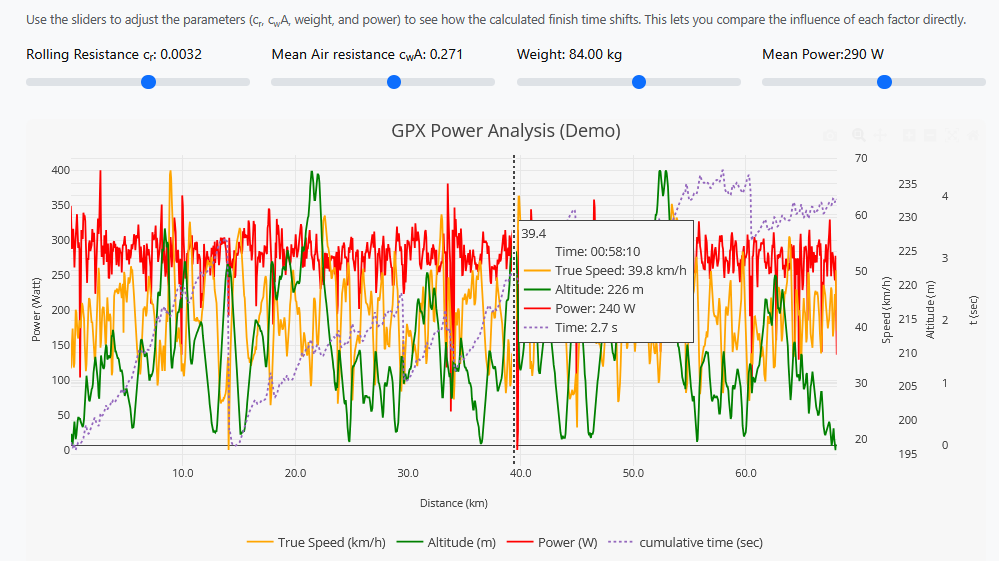
You upload your course and first get a reference time based on your current values. Then you can change individual factors:
- rolling resistance through Crr
- aerodynamics through CdA
- weight
- average power
It works like a simple comparison: You move a slider and immediately see how your new target time and time difference change.
For a real analysis of your own ride, you need a power meter, because the calculation is based on the power you actually produced.
If you do not have a power meter, you can still use GPXPower: You can save a simulation result directly and work with that. Alternatively, you can use PowerIQ to calculate an estimated power value. This gives you a useful starting point for your course analysis even without a power meter.
For example, you can see:
- How much time would I save with less weight?
- What happens if I can ride 5 watts more?
- How much does a better aero position change my time?
- Are faster tires worth it on this exact course?
- Where on the course do I gain or lose the most time?
This does not only answer whether you can get faster. It also shows which factor creates the biggest time gain for your race.
That matters especially for triathletes, because the fastest bike split is not always the best race strategy. You still need to run afterwards. A performance analysis can therefore help not only with equipment choices, but also with pacing.
Conclusion
If you want to get faster on the bike, you do not automatically need to train more or spend more money.
The first step is understanding what is actually slowing you down.
For some athletes, it is aerodynamics. For others, it is weight. For others, it is rolling resistance. And very often, it is the way power is distributed across the race.
A performance analysis helps you stop guessing and start comparing these factors more clearly.
Instead of only asking “How do I get faster?”, you can see which factor really matters on your specific course.
Test your own course
Want to know what would actually make you faster on your course?
Try the GPXPower Demo. You will see your reference time, change individual sliders for rolling resistance, aerodynamics, weight or power, and immediately see how your target time changes.
These articles might also interest you:
- 10 Watts More or 10 lb Less: What Actually Makes You Faster on the Ironman Bike Course? — 03.06.2026
- From TrackIQ pacing to your device: FIT export for Garmin® Edge & ZWO workouts for Zwift®/MyWhoosh® etc. — 14.02.2026
- TrackIQ Power Strategy: How Simulation Reveals Where Your Watts Really Make You Faster — 25.10.2025
- Master Your Race Day with RaceYourTrack — 24.10.2025