Triathlon Aero Position: How Much Does a Lower Position Really Save?
Triathlon Aero Position: How Much Does a Lower Position Really Save?
A lower aero position looks like the most obvious path to a faster bike split. Less frontal area, less drag, more speed — that is the basic idea. In practice, though, the topic is far more interesting than that. A more aerodynamic position does not automatically make you faster. It only helps if the gain from a lower CdA is bigger than the power loss you may have to accept in that position.
That is where this gets genuinely useful. The real question is not simply whether lower is faster. It is this: how much does a lower aero position actually save on your course, and how many watts can you afford to lose before the benefit disappears?
What the aero-position question is really about
When triathletes talk about aerodynamics, the conversation often jumps straight to helmets, wheels, hydration systems, or skinsuits. In reality, position is usually the bigger lever. A lower, narrower, calmer upper body can reduce the drag of the entire rider-bike system substantially. That effect is captured by CdA, the product of drag coefficient and frontal area.
A lower CdA means you need less power to hold the same speed. Or, from the other direction, you can go faster at the same power. That part is simple. The harder part begins where the lower position is aerodynamically better but biomechanically worse. Your breathing may feel more restricted. Your hip angle may become less effective. You may be able to hold the position for ten minutes, but not for an hour. Or you may lose stability and control when fatigue builds.
That is why this is not really a style question. It is an optimization problem. The goal is not to find the lowest position. The goal is to find the fastest combination of aerodynamics, sustainable power, stability, and durability.
Why a lower position is not automatically faster
The most common mistake in aero discussions is perfectly understandable: if drag is lower, speed must be higher. That is only true if power does not drop too much in the process.
A simplified example makes the logic clear. Imagine you currently ride in a position with a CdA of about 0.36. If you move into a significantly lower aero position and reduce that to 0.30, that is a big aerodynamic step. At race speed, that difference can be worth a lot of watts. But if the new position costs you so much power that the drag savings are wiped out, the change does not actually help your bike split.
That is why the key question is never just: How aero is the position?
The more useful question is: How aero is it while you are still producing real race power in it?
And there is another layer to this. A position does not only have to look fast in a fit studio or during a short test. It has to remain stable under load over the full duration of the effort. A theoretically strong position that you cannot hold after twenty minutes is often worth less than a slightly less aggressive setup that you can ride cleanly and consistently.
How big the aero effect can actually be
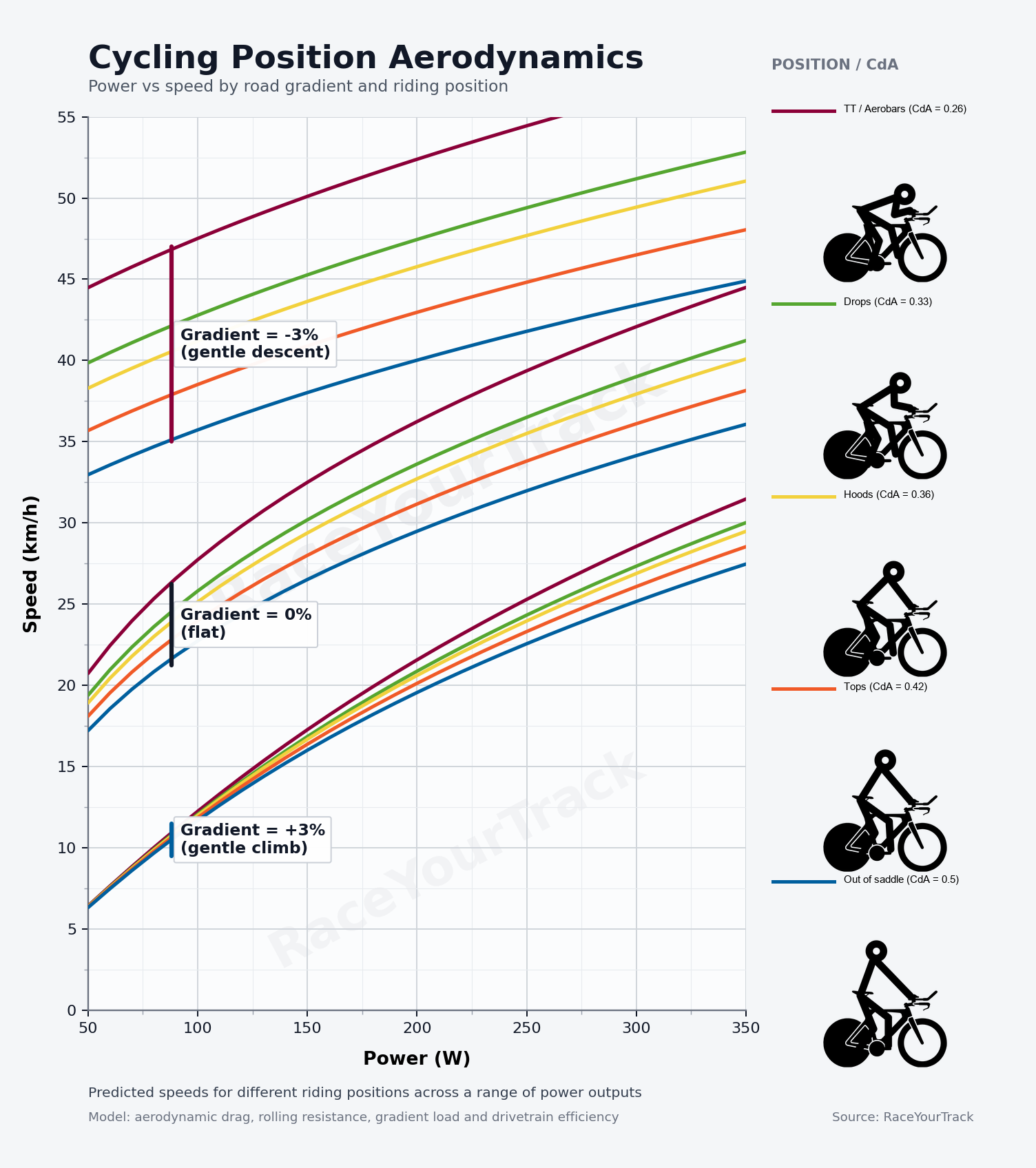
The effect of a positional change becomes especially important at higher speed. The physics are straightforward: the power needed to overcome aerodynamic drag rises very steeply as speed increases. That is why a small change in CdA may feel modest at 25 km/h but suddenly becomes highly valuable at 40 km/h.
That is also why aerodynamics matters so much on flat, fast, or slightly downhill sections. Those are the parts of the course where drag takes up a large share of your power. If you reduce CdA there, you shift the whole performance equation in your favor.
On slow climbs, the picture changes. Speed falls, and drag becomes relatively less important. Gravity, sustainable force production, and positional comfort matter more. An extremely low setup can even become counterproductive if it restricts breathing or reduces how effectively you can pedal.
This is one of the most important lessons in aero strategy: the same position can be worth a huge amount in one part of the course and very little in another.
The real key: your break-even point
In practice, what matters most is the break-even point. This is the point where aero gain and power loss exactly cancel each other out.
As long as the benefit from the lower CdA is larger than the watts you lose in the more aggressive position, the lower position remains faster. Once the power loss becomes larger than the aerodynamic gain, the equation flips.
That is why this question becomes so useful for ambitious triathletes. The break-even point is never generic. It is always individual.
It depends on your current CdA. It depends on how much lower you can realistically get it. It depends on how many watts you lose or do not lose in the new position. And it depends heavily on the course.
On a flat, exposed triathlon bike course with high speed and headwind, you can usually afford a larger power loss and still come out ahead because the aero lever is so strong. On a course with more climbing and lower average speeds, the margin becomes smaller. A position that looks highly aerodynamic on paper can become slower in the real race if the power cost is too high.
When the aero position matters most
A lower position becomes especially valuable whenever air speed is high. That does not only mean high road speed. It also means headwind. Even if your bike computer shows a moderate number, the effective air speed may already be high enough for aerodynamics to dominate again.
Typical situations where an aero position can be especially valuable include:
- flat and fast sections
- slightly downhill terrain
- long straight exposed roads
- open sections with headwind
- triathlon and time-trial courses ridden at sustained high speed
The effect is usually less decisive where speed stays low, such as on steep climbs or in sections where rhythm is constantly interrupted.
That does not mean aerodynamics stops mattering there. It simply means the lever becomes smaller. And once the lever becomes smaller, any power loss matters more.
What many triathletes underestimate about position
Most aero conversations revolve around numbers. The more interesting part is often the human side of the equation. There is frequently a big gap between a position that tests well and a position that is actually ridden well in a race.
A rider may look extremely low and clean in a short fit-session photo, then drift upward after thirty minutes in a long race. The head comes up. The shoulders open. The elbows get wider. The back becomes less stable. On paper the position is the same; in practice the CdA has already climbed again.
That is why a good aero position is not just low. It is also:
- stable
- repeatable
- sustainable over race duration
- compatible with good breathing
- technically controllable under fatigue
For triathletes, that matters even more because position has to work for a long, uninterrupted effort. Sometimes a slightly less aggressive setup that stays stable for the full ride is faster overall than a very low position that falls apart once fatigue accumulates.
What this means for triathlon racing
In triathlon, the aero-position question is especially important because two things happen at once. First, bike-leg speeds are often high enough that drag becomes a major performance limiter. Second, the position has to remain economical over a long duration without compromising the run too heavily afterward.
That is why the best triathlon position is rarely just the one with the absolute lowest drag in isolation. It is the one that still lets you:
- hold power steadily
- stay mechanically quiet
- fuel and hydrate well
- control muscle tension in the neck, shoulders, hips, and lower back
- arrive at T2 in a condition that still supports a good run
A position that looks incredible in a short aero test can be the wrong choice for a 70.3 or full-distance race if it reduces your ability to pace smoothly or leaves you too compromised to run well.
How to make the right decision
If you want to approach the issue properly, you do not need generic aero charts. You need a realistic simulation.
A sensible process starts by defining two or more realistic positions, for example your current setup and a lower alternative. Then you assign plausible CdA assumptions to both positions and pair those with realistic power assumptions. The important point is not to use wishful thinking, but the power you can actually sustain in each position.
In the final step, you compare the positions on your own course. That is where you see on which sections the aero gain is large enough to outweigh a power loss, and where it is not.
That exact logic can be explored with the Bike Calculator.
If you want to revisit the underlying physics first — in other words, why drag becomes so dominant at higher speed — the companion article is here: How Air Resistance Affects Cycling: Watts, Drag, and Resistance Split. If you want to estimate your own CdA from field data, the methodology is here: How does RaceYourTrack calculate aerodynamic drag?.
Conclusion
A lower aero position can save a great deal of time, but not because lower is automatically magical. It only helps when the aerodynamic gain from the lower drag remains larger than what you lose in power, stability, or durability.
That is why aero position is not a style topic. It is a performance question. The best position is not the most extreme one. It is the fastest one under real conditions. And you do not find that through guesswork, but through the interaction of CdA, power, and course demands.
If you want to see this clearly for your own setup, compare a more upright and a lower position with realistic assumptions and find out where your personal break-even actually is.