10 Watts More or 10 lb Less: What Actually Makes You Faster on the Ironman Bike Course?
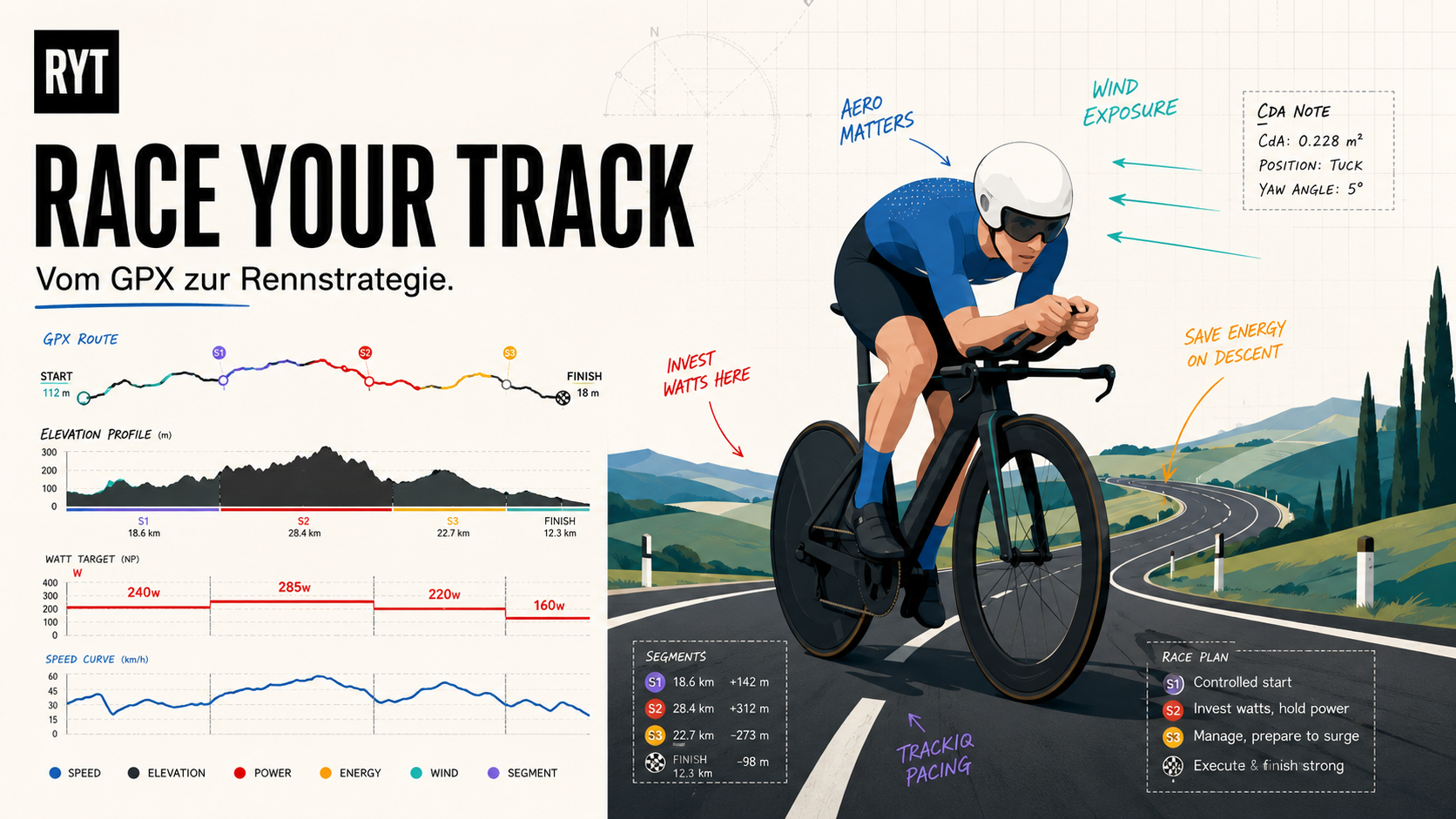
You are getting ready for your next Ironman and wondering: Should you train harder, lose weight, or focus on improving your aerodynamics? Forums are full of opinions, but what actually gives you the biggest time gain on your course? This is exactly where a physics-based simulation helps — it shows how 10 extra watts, 10 lb less weight, or a lower CdA could affect your bike split.
The dilemma: More watts, less weight, or better aerodynamics?
Many ambitious age-group triathletes face the same decision: Should the next training block focus on increasing power, is weight loss the bigger lever, or is an aerodynamic upgrade worth the investment? In forums and magazines, you often see claims like “10 lb less matters more on climbs than any aero upgrade” or “10 more watts makes you faster everywhere.” These blanket statements fall short because they ignore the key interaction between course profile, speed, and setup. If you rely on generic advice, you risk spending time and money in the wrong place — and missing your real potential.
The important question is not which lever matters most in theory, but how its effect changes depending on the course profile and your setup. On a flat course like Ironman Hamburg, an aerodynamic advantage or more watts can have a particularly strong effect, while on a hillier course like Nice, weight becomes more relevant. The interactions between power, weight, CdA, and pacing are rarely explained in a way that is easy to apply. If you really want to know which lever matters most on your own course, you need more than tables or forum opinions. Here you can find a basic overview of the factors that affect your bike split.
A common mistake: Many athletes assume that more power always has the biggest effect. In practice, the time gain depends on which resistance dominates on each section of the course — and how power, CdA, and weight influence one another. Your power distribution, or pacing, along the course also determines how much each lever can actually help.
Physics on the course: When does each type of resistance dominate?
Whether 10 extra watts, 10 lb less weight, or a lower CdA truly makes you faster is decided not in the lab, but on the course — section by section. The three most important forces working against you on the bike are:
- Aerodynamic drag (CdA): Increases with the square of speed. The faster you ride, the more power you need to overcome air resistance. On flat, fast sections, aerodynamic drag dominates — but the time gain from more watts is only maximized if your CdA is not already the limiting factor. CdA improvements and extra watts always work together with your setup and speed.
- Gravity (weight): On climbs, every pound matters — but not in isolation. What counts is total system weight: athlete, bike, and gear. On long or steep climbs, lower weight is directly noticeable; on flat courses, it has much less impact.
- Rolling resistance (Crr): Usually plays a smaller role, but it can become measurable on rough pavement or over very long distances.
The interaction of these forces is dynamic. On a flat course like Ironman Hamburg, 10 extra watts can have a larger effect than 10 lb less weight — if aerodynamic drag is not already consuming most of the power and your CdA is not the main limiting factor. On a hillier course like Nice, the balance shifts: weight can become the dominant factor, especially on longer climbs. On rolling courses, the dominant resistance changes from section to section, so the optimal strategy varies across the route. The effect of each lever always depends on which resistance dominates each section and how strongly watts, weight, or CdA can influence it. You can learn more in the article How does aerodynamic drag affect cycling?.
Pacing — how you distribute your power along the course — also affects how efficiently you can use each lever. A targeted power distribution can mean that one watt in the right place saves more time than one watt applied evenly across the entire course. Read here how TrackIQ physically optimizes power distribution along the course.
Compare scenarios: How to find your biggest lever
Generic tables or percentage values only help to a limited extent. The key question is: How do your times change on your course when you adjust one of these levers? This is where simulation becomes useful because it brings together all relevant factors: course profile, power, weight, CdA, rolling resistance, wind, and pacing.
The most useful approach is to compare clearly defined scenarios:
- Your current setup: The status quo, using realistic values for power, weight, and CdA. Ideally, this is based on imported GPX/TCX and power-meter-based values.
- +10 watts: How does your bike split change if you can average 10 more watts? Example assumption, not a universal prediction: On flat courses, the effect can be larger than on hilly courses, but only if aerodynamic drag is not already the dominant limitation.
- -10 lb: What happens if you reduce total system weight by 10 lb, including athlete, bike, and gear? The time gain is much more noticeable on climbs than on flat sections.
- Lower CdA: How does a realistic improvement in aerodynamic drag affect your time — for example through an optimized position or an aero upgrade? Learn here how to estimate your CdA from power meter data.
- Combinations: Often, the biggest potential comes from combining small improvements — for example 5 more watts, 4 lb less weight, and a slightly lower CdA. In the simulation, you can look at these effects additively and interactively to see how the combination affects different course sections.
With a simulation, you can not only compare these scenarios side by side, but also evaluate individual course segments. The key is interpretation: If the time gain from one single change is smaller across all segments than the gain from a combination, a coordinated package of training, setup, and equipment often makes more sense. Simulation makes assumptions transparent and provides a robust estimate instead of forcing you to rely on generic rules of thumb.
Mini example for interpretation:
Imagine you are planning an Ironman on a course with 4,000 ft of elevation gain and long flat sections. You simulate the following scenarios: - Your current setup - 10 more watts of average power - 10 lb less total system weight - Lower CdA from an optimized position
The simulation shows that on the long flat sections, the lower CdA produces the biggest time gain, while on the climbs, lower weight has a stronger effect. The 10 extra watts help on both types of terrain, but the relative advantage shifts depending on each segment and its resistance mix. Only a segment-based analysis shows where your effort pays off most — and whether combining several levers makes sense.
Make the decision: What helps YOU most on your course?
The best decision comes from understanding the interactions between power, weight, CdA, course profile, and pacing — and comparing your assumptions transparently. Simulation gives you a solid foundation because it makes the effects of each lever on your target time visible.
So how do you find out which lever has the biggest impact on your course? Compare the target times of your clearly defined scenarios directly. The lever that creates the biggest difference from your baseline is the dominant factor on your course. Pay attention to the course sections where the time differences are most visible — for example flat sections, where aero and watts matter most, or climbs, where weight and watts matter more. The combination of scenario comparison and segment-level analysis shows where your potential is.
Important: No model is free from uncertainty. The quality of the simulation depends on the input values you choose — for example how realistic your CdA estimate is or how consistently you can actually hold the target power. Still, comparing clearly defined scenarios is the clearest way to avoid poor decisions.
For age-group athletes with a power meter, GPX data, and a specific goal, simulation can reveal differences that otherwise stay hidden. If you want to know which lever changes your target time the most on your course, simulate your own setup — and do not rely on generic averages.
These articles might also interest you:
- Why am I not getting faster on the bike? Weight, watts, tires and aerodynamics explained simply — 09.05.2026
- From TrackIQ pacing to your device: FIT export for Garmin® Edge & ZWO workouts for Zwift®/MyWhoosh® etc. — 14.02.2026
- TrackIQ Power Strategy: How Simulation Reveals Where Your Watts Really Make You Faster — 25.10.2025
- Master Your Race Day with RaceYourTrack — 24.10.2025